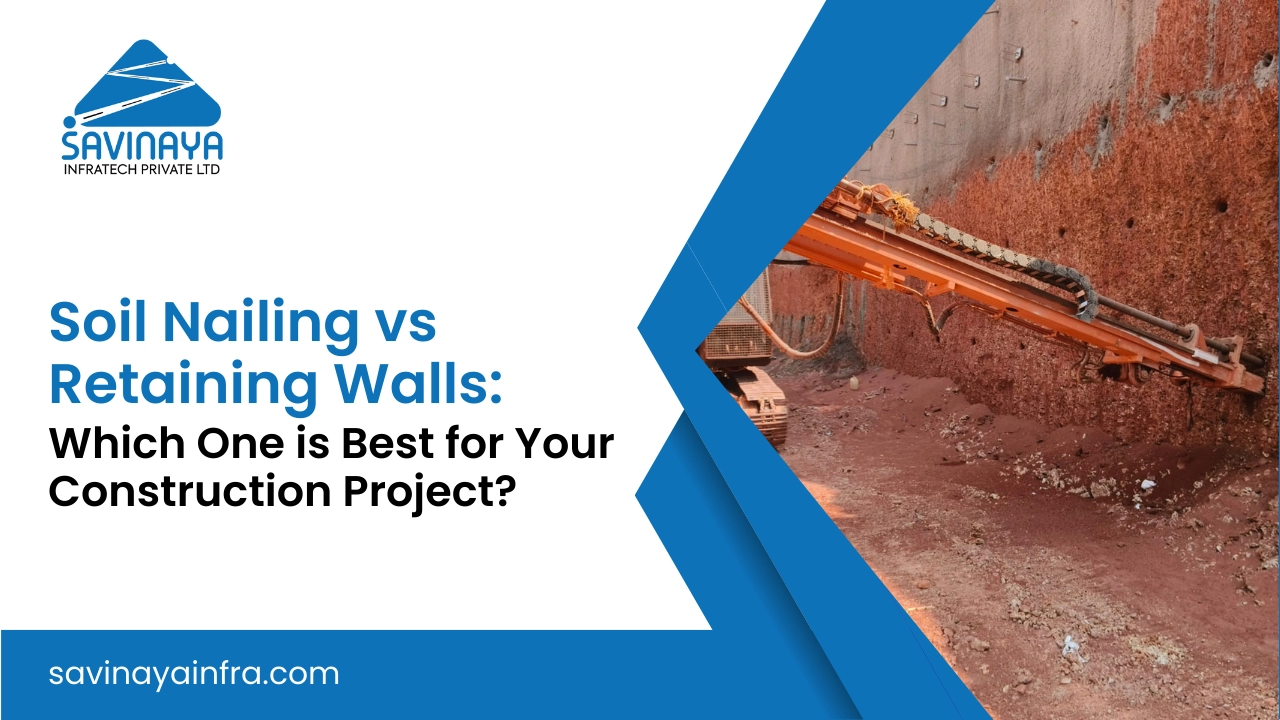
Imagine standing at the edge of a steep slope where construction is about to begin. You’re responsible for ensuring the site remains stable, safe, and structurally sound. The two most common techniques in front of you are soil nailing and retaining walls. Both methods have been tested over decades across projects ranging from highways to basements, hill roads to urban excavations.
But how do you determine which one fits your project? Is it a matter of cost, soil condition, available space, or something more? This detailed comparison of soil nailing vs retaining walls will walk you through each method, its uses, benefits, and when each should be considered, helping you make a confident decision backed by facts and practical knowledge.
Key Takeaways
- Soil nailing and retaining walls are both effective methods for earth retention and slope stabilization, but they serve different purposes depending on site conditions and project goals.
- Soil nailing reinforces existing soil by installing steel bars into the ground, making it ideal for deep excavations, limited access areas, and top-down construction.
- Retaining walls act as physical barriers that hold back soil and are commonly used in landscaping, road embankments, and areas where structural visibility and aesthetics are important.
- Soil nailing is generally faster to install, more cost-effective for deep cuts, and less disruptive to the surroundings.
- Retaining walls offer greater load-bearing capacity, long-term durability, and design flexibility with materials like concrete, stone, or timber.
- Choosing between the two depends on factors like soil type, slope angle, available space, drainage needs, and project budget.
Table of Contents
What is Soil Nailing?
Soil nailing is a ground reinforcement method used to stabilize slopes, excavations, and vertical cuts. The technique involves inserting steel bars (called nails) into the soil or ground at an angle. These nails are installed into pre-drilled holes and then grouted into place, allowing them to work together with the surrounding earth to create a more stable mass.
Instead of resisting soil pressure with an external structure, soil nailing strengthens the internal body of soil. It turns the existing earth into a load-bearing structure, which is both efficient and effective in many scenarios.
Types of Soil Nailing
Several types of soil nailing systems are in use today, depending on project requirements and soil conditions:
1. Grouted Soil Nails
These are the most commonly used. After the hole is drilled, a steel bar is inserted and then grouted with cement or a similar material. The grout helps anchor the bar to the surrounding soil.
2. Self-Drilling Soil Nails
In this method, the bar drills its own hole as it is installed. These nails are useful in loose or collapsing soils where conventional drilling might be problematic.
3. Driven Soil Nails
These are hammered into the ground without drilling. While faster, they are not suitable for all types of soil and are typically used in specific, less demanding applications.
4. Launched Soil Nails
These are installed by firing them into the ground using pneumatic pressure. This method is typically used for temporary stabilization or rapid-response situations.
Soil nailing is frequently used in the following construction scenarios:
- Stabilizing roadside or highway slopes to prevent landslides
- Supporting deep excavations in congested urban areas
- Reinforcing tunnel entrances and exits
- Repairing or upgrading failing retaining walls
- Strengthening existing slopes during road-widening projects
It’s an adaptable method that performs well in both temporary and permanent solutions.
Advantages of Soil Nailing
Soil nailing offers several practical benefits that make it a preferred method in many geotechnical and excavation projects, especially where speed, space, and cost are important factors.
1. Less Excavation and Top-Down Installation
Soil nailing requires less excavation and can be installed from the top down, allowing other construction activities to proceed without major delays.
2. Suitable for Confined or Limited Access Areas
This method can be applied even in tight or restricted spaces, making it ideal for urban projects or sites with access limitations.
3. Flexible Design Options
Soil nailing provides flexibility in layout and structural design, adapting to various excavation shapes and project needs.
4. Cost-Effective for Deep Excavations
It is generally more economical compared to other methods when used for deep excavation and slope stabilization.
5. Minimal Disturbance to Surroundings
The installation process causes minimal vibration and surface disruption, reducing the impact on nearby structures and environments.
6. Adaptable to Various Soil Conditions
Soil nailing works effectively across a wide range of soil types, including cohesive and granular soils, enhancing its usability across different sites.
What is a Retaining Wall?
A retaining wall is a rigid structure built to hold or retain soil behind it. It is designed to resist lateral soil pressure and maintain differences in ground elevation. Retaining walls do not reinforce the existing soil but rather act as a barrier, preventing soil movement.
These walls are constructed using various materials such as concrete, stone, brick, steel, or even treated timber. The design and materials depend on the wall height, soil conditions, and the amount of pressure expected from the retained soil.
Types of Retaining Walls
Different retaining wall types are available based on their function and structure:
1. Gravity Retaining Walls
These rely on their own mass to hold back the soil. Made from heavy materials like stone or concrete, they are simple but require more space.
2. Cantilevered Retaining Walls
These have a stem and base slab, with the base extending beneath the retained soil. Reinforced with steel, this type uses leverage to resist pressure.
3. Anchored Retaining Walls
These walls are supported by anchors or tiebacks inserted deep into the ground. Useful for taller walls or when space is restricted.
4. Sheet Pile Retaining Walls
Commonly used near water bodies or soft soils. Thin, interlocking steel or vinyl sheets are driven vertically into the ground.
Retaining Wall Installation Overview
The process of building a retaining wall usually includes the following steps:
- Site survey and excavation to create a stable foundation
- Foundation construction, often involving compacted gravel or poured concrete
- Wall assembly, using blocks, concrete, or other materials
- Drainage system installation to manage water pressure behind the wall
- Backfilling and compaction to support the structure and prevent settling
Proper design, including drainage considerations, is necessary to prevent bulging or failure over time.
Common Applications of Retaining Walls
Retaining walls are widely used in many situations:
- Creating level terraces in sloped gardens and landscapes
- Supporting elevated roads or railways
- Preventing erosion in hilly residential areas
- Providing structural support for basement foundations
- Managing waterfront and shoreline areas
They are valued both for their structural function and for their visual appeal in landscape design.
Advantages of Retaining Walls
Soil nailing offers several practical benefits that make it a preferred method in many geotechnical and excavation projects, especially where speed, space, and cost are important factors.
1. Less Excavation and Top-Down Installation
Soil nailing requires less excavation and can be installed from the top down, allowing other construction activities to proceed without major delays.
2. Suitable for Confined or Limited Access Areas
This method can be applied even in tight or restricted spaces, making it ideal for urban projects or sites with access limitations.
3. Flexible Design Options
Soil nailing provides flexibility in layout and structural design, adapting to various excavation shapes and project needs.
4. Cost-Effective for Deep Excavations
It is generally more economical compared to other methods when used for deep excavation and slope stabilization.
5. Minimal Disturbance to Surroundings
The installation process causes minimal vibration and surface disruption, reducing the impact on nearby structures and environments.
6. Adaptable to Various Soil Conditions
Soil nailing works effectively across a wide range of soil types, including cohesive and granular soils, enhancing its usability across different sites.
Soil Nailing vs Retaining Walls: Key Differences
Before deciding which method to use, it’s helpful to compare how each one performs across key factors like design, cost, space requirements, and application.
| Feature | Soil Nailing | Retaining Wall |
| Core Function | Reinforces existing soil | Holds back soil with a barrier |
| Space Requirement | Minimal | Requires more space at the base |
| Visual Appearance | Mostly hidden | Can be a visible design feature |
| Installation Time | Often quicker | Can take more time and labor |
| Flexibility | High in design and application | More rigid in layout |
| Cost | Generally lower for deep excavations | Can be higher for large or decorative walls |
| Maintenance | Low if installed correctly | May need maintenance depending on materials and drainage |
You May Also Read: Gabion Walls vs Retaining Walls: What Are the Differences & Cost Comparison
When Are Retaining Walls the Better Choice?
Retaining walls are well-suited for projects that require both structural integrity and visual impact. If the area being stabilized is visible to the public or part of a designed landscape, retaining walls provide both function and form. They are also the right fit when heavy loads need to be managed or where soft or loose soils are present that do not respond well to soil nailing.
In hilly residential zones, garden terraces, and commercial spaces with visible retaining structures, retaining walls are often preferred.
When is Soil Nailing a Better Choice?
Soil nailing is a practical solution for projects involving deep excavation or slope stabilization where minimal disruption is important. It is often used on sites with limited access or where fast, top-down construction is preferred. For infrastructure such as road widening projects, tunnel portals, hilly areas or urban excavations, soil nailing allows flexibility and efficiency.
Soil nailing is also suitable for vertical or near-vertical cuts, especially in tight spaces or projects where existing slopes must be retained rather than replaced.
Cost Comparison: Soil Nailing vs Retaining Walls
From a financial perspective, soil nailing typically involves lower material and labor costs, especially in deep excavations or confined areas. It often results in faster completion times, which also reduces project overheads.
Retaining walls, on the other hand, require more materials, especially if concrete or stone is used. They also demand additional steps such as drainage installations and foundation work, which can increase the overall cost.
However, retaining walls may offer better value in scenarios where aesthetics and long-term durability are priorities. In some cases, their initial investment pays off in reduced maintenance and better load-bearing performance over time.
You May Also Read: How Much Does Soil Nailing Cost? A Complete Price Breakdown
Soil Nailing vs Retaining Wall? Which One is Right for Your Project
Every construction site is unique. The right choice between soil nailing and a retaining wall depends on your project goals, available space, expected soil pressure, budget, and how visible the structure will be.
If your project involves deep cuts, narrow sites, or temporary stabilization, soil nailing offers a faster and more cost-effective solution. For projects that require strong visual impact, load-bearing capacity, and long-term permanence, retaining walls may be more suitable.
By evaluating site conditions, structural needs, and design expectations, you can determine which option aligns with the overall goals of your project.
You May Also Read: Best Soil Nailing Techniques for Enhancing Soil Stability in Construction
Conclusion
The discussion around soil nailing vs retaining wall is not about finding a universally better method. It is about selecting the right solution based on the demands of the site and the desired outcome. Each method delivers reliable results, yet they are designed to address different site conditions and project goals.
For professional guidance and high-quality execution, Savinaya Infratech offers the expertise and experience needed to deliver reliable ground engineering solutions. Our experience in soil stabilization, retaining wall systems, and geotechnical solutions allows us to guide clients toward smart, well-planned decisions that lead to stable and successful outcomes.
Frequently Asked Questions
1. Is soil nailing better than a retaining wall?
The answer depends on the specific needs of your project. Soil nailing is often better suited for deep excavations, limited-access areas, and projects requiring a flexible, cost-effective solution. On the other hand, retaining walls offer more structural visibility and are typically used when aesthetics, high load support, or long-term permanence is a top priority. Rather than asking which is better overall, it’s more helpful to assess which option fits your site conditions and design goals best.
2. Which solution works better for steep slopes?
For steep slopes, both soil nailing and retaining walls can be effective. However, soil nailing is frequently used to stabilize existing steep slopes without requiring large structural additions, making it ideal for road cuttings, embankments, and excavation faces. Retaining walls may be used when the slope needs to be reshaped or when visual impact is important, such as in landscaped environments.
3. Is soil nailing expensive?
No, soil nailing is not expensive. The cost advantage comes from reduced material usage and faster installation. However, the final price can vary depending on factors like soil type, project depth, nail length, and access to the site.
4. Can soil nailing be used in wet soil conditions?
Yes, soil nailing can be applied in wet or moist soil conditions, but it requires additional considerations. Special grouting techniques, corrosion-resistant materials, and proper drainage systems are typically integrated to ensure long-term performance. A thorough geotechnical assessment is recommended before proceeding in such conditions to design the most effective system.