Construction on slopes, near retaining structures, or within deep excavations requires dependable ground support. Loose, weak, weathered, or water-affected soil can shift, erode, or collapse, affecting roads, buildings, foundations, and nearby infrastructure.
Soil nailing is a ground-stabilisation solution that reinforces the existing soil mass from within, helping improve slope stability and reduce the risk of movement. This method is used for road and highway slopes, tunnel approaches, deep excavations, building foundations, embankments, landslide-prone locations, and rehabilitation of unstable retaining systems.
Savinaya Infratech, a trusted soil nailing contractor, provides soil nailing, reinforced soil slope solutions, gabion walls, erosion protection, soil anchoring, shotcreting, retaining-wall solutions, and rehabilitation of unstable RS walls through soil nailing.
Key Takeaways
- Soil nailing strengthens weak soil, slopes, and excavations.
- Steel nails reinforce the existing soil from within.
- Drilling, grouting, facing, and drainage are key installation steps.
- Soil nailing can be used for temporary or permanent works.
- Common applications include highways, slopes, excavations, and retaining structures.
- Soil nailing can reduce excavation and material requirements.
- Proper drainage is essential for long-term performance.
- Nail length and spacing depend on soil and site conditions.
- Soil nailing can work well in constrained construction sites.
- Proper design, testing, and monitoring are critical for safety.
Table of Contents
What is Soil Nailing?
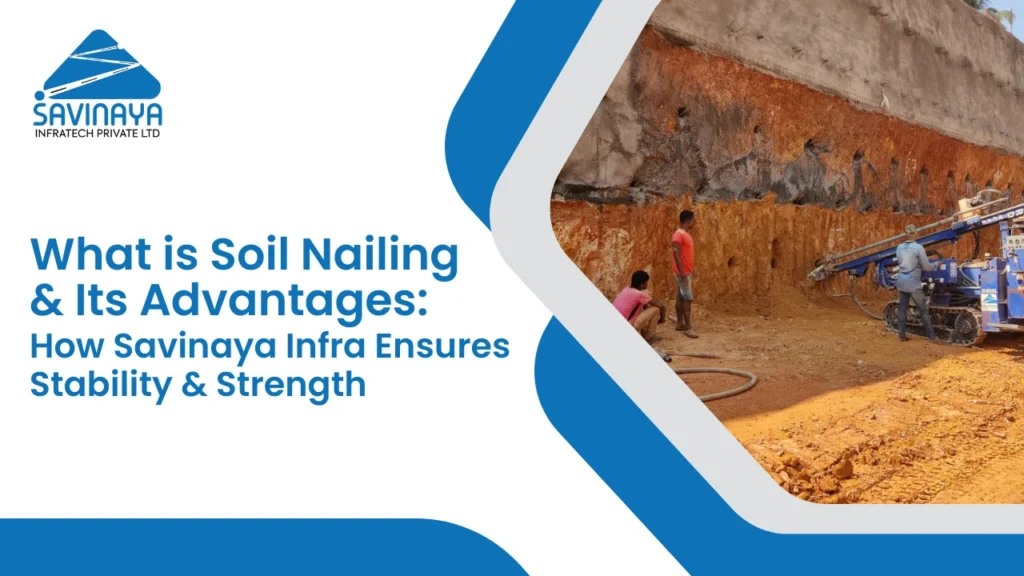
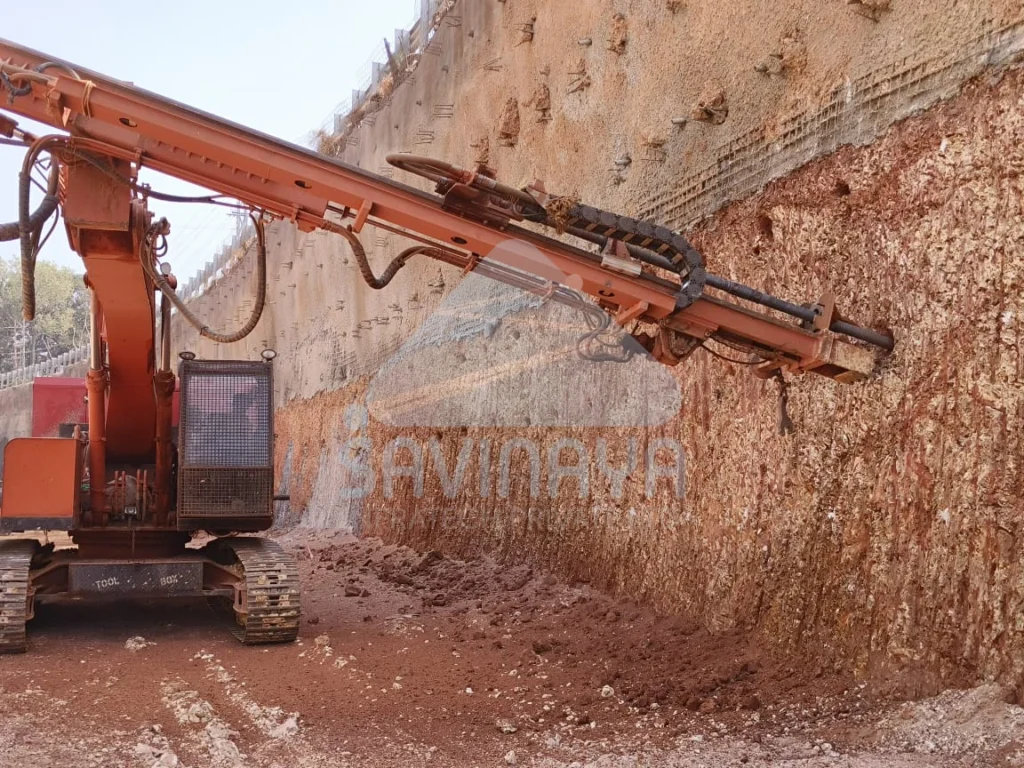
Soil nailing is a technique used in construction to strengthen and stabilize loose or weak soil. The process involves drilling steel rods (called soil nails) into the ground at an angle. These nails are placed in a grid-like pattern and are secured with materials like shotcrete or mesh to hold the soil in place. This process helps prevent soil erosion, soil movement, or collapse, which is especially important in areas with steep slopes or deep excavations.
This method is widely used in various construction projects, such as roads, tunnels, and building foundations, especially in areas where the ground is unstable.
How Does Soil Nailing Work?
The soil nailing process strengthens soil by installing reinforcement that extends from the exposed slope or excavation face into more stable ground behind the potential failure zone. If the soil tends to move outward, the nails develop tensile resistance and help the entire reinforced soil mass behave more cohesively.
1. Site Assessment and Soil Nail Design
Before soil nail construction begins, engineers assess the soil and rock profile, groundwater, slope height and angle, nearby buildings, utility lines, access limitations, and surcharge loads. This information is used for the soil nail design, including nail length, diameter, spacing, inclination, bar strength, grout bond, facing arrangement, drainage, corrosion protection, and testing requirements.
2. Staged Excavation
The soil nailing method is normally performed from top to bottom. A shallow section of the slope or excavation is exposed first, then stabilised before work proceeds lower. This limits the unsupported height of soil during construction and helps maintain stability throughout the project.
3. Drilling, Grouting and Nail Installation
Holes are drilled at the required locations and angles. Steel bars are inserted and grouted, creating a bond between the reinforcement and surrounding soil. The completed nails then provide internal support to the ground.
4. Facing and Drainage Installation
Wire mesh is fixed over the exposed face and connected to the nail heads through bearing plates. Shotcrete is applied over the mesh to provide surface support and protect the soil between nails. Drainage strips, weep holes, or other measures may also be installed because water can reduce soil strength and affect wall or slope performance.
What are the Types of Soil Nailing?
The appropriate types of soil nailing depend on the soil, drilling conditions, access, groundwater, required design life, and construction requirements.
1. Drilled and Grouted Soil Nails
This is the commonly used soil nailing technique. A hole is drilled, a steel bar is inserted, and cement grout is placed around the bar to bond it with the surrounding soil.
2. Driven Soil Nails
Driven nails are installed directly into suitable ground without drilling. This can be faster in certain soils, but vibration, installation control, and hard inclusions must be considered.
3. Hollow Bar and Self-Drilling Soil Nails
Hollow-bar or self-drilling nails allow drilling and grouting through the reinforcement element. These can be useful where a pre-drilled hole may collapse due to loose or unstable ground conditions.
4. Top-Down and Bottom-Up Nailing
Top-down soil nailing work begins from the top of a slope or excavation and progresses in controlled stages. Bottom-up nailing can be used for specific repair or construction situations, depending on access and the engineered solution.
How is Soil Nailing Used in India?
In India, the use of soil nailing has grown rapidly due to the increasing number of infrastructure projects, especially in hilly and mountainous regions. Here are some key facts about soil nailing in India:
1. Widely Used in Hill Regions
Soil nailing is frequently used in regions like Himachal Pradesh, Uttarakhand, and the Northeastern states where there are steep slopes. It helps prevent landslides and ensures the stability of roads and highways in these areas.
2. Highway and Road Projects
About 20-30% of road construction projects in hilly terrains, such as the Himalayas, rely on soil nailing to keep roads stable. This method is commonly used to stabilize slopes alongside highways.
3. Cost Savings
Soil nailing is considered a cost-effective solution for stabilizing soil. In many projects, it can reduce costs by up to 40% compared to traditional methods like building massive retaining walls.
4. Metro Projects
In cities like Delhi and Mumbai, soil nailing has been successfully used in the construction of metro tunnels and stations. It ensures that deep excavations, like underground metro stations, are stable and safe.
5. Landslide-Prone Areas
In regions like Kerala and Sikkim, where landslides are common during the monsoon, soil nailing has become a go-to method for protecting roads and infrastructure from soil collapse.
What are the Advantages of Soil Nailing?
The core advantages of soil nailing arise from reinforcing existing ground, which can reduce the need for heavy external retaining structures where site conditions are suitable.
1. Cost-Effective
The biggest advantage of soil nailing is that it’s a budget-friendly option for stabilizing soil. Compared to building large retaining walls, soil nailing saves both time and money, making it a preferred choice for many projects.
2. Works in Various Soil Conditions
Whether your project is in rocky terrain or loose soil, soil nailing can be adapted to fit the needs of the site. This flexibility makes it a popular choice for different types of construction, from roads to buildings.
3. Less Disruption to the Surrounding Area
Traditional methods of stabilizing soil often involve heavy excavation, which can disrupt the surrounding environment. With soil nailing, there’s minimal digging, which means less impact on nearby structures and landscapes.
4. Improves Safety and Durability
Soil nailing provides long-lasting stability. The steel nails reinforce the soil, reducing the risk of landslides or collapses. Plus, the nails are durable, so they’ll continue to provide support for many years.
One of the biggest advantages of soil nailing is that it’s a budget-friendly option for stabilizing soil. Compared to building large retaining walls, soil nailing saves both time and money, making it a preferred choice for many projects.
5. Works in Various Soil Conditions
Whether your project is in rocky terrain or loose soil, soil nailing can be adapted to fit the needs of the site. This flexibility makes it a popular choice for different types of construction, from roads to buildings.
6. Less Disruption to the Surrounding Area
Traditional methods of stabilizing soil often involve heavy excavation, which can disrupt the surrounding environment. With soil nailing, there’s minimal digging, which means less impact on nearby structures and landscapes.
7. Improves Safety and Durability
Soil nailing provides long-lasting stability. The steel nails reinforce the soil, reducing the risk of landslides or collapses. Plus, the nails are durable, so they’ll continue to provide support for many years.
8. Flexibility
The system can be adapted to road cuts, slopes, excavations, curved faces, and constrained sites. Nail dimensions, spacing, inclination, facing, and drainage are adjusted to suit the ground and loading conditions.
9. Eco-Friendly
By reinforcing the existing soil mass, the solution can reduce major excavation, disposal of removed soil, and the need to import replacement fill. It can also reduce disruption to nearby landscape and infrastructure.
10. Fast and Efficient
The staged soil nailing process allows support to be installed as excavation progresses. This can offer a practical sequence for projects where early slope or excavation stability is required.
11. Easier to Install than Anchor Walls
Soil nails are usually passive reinforcement elements. Unlike prestressed anchor walls, they generally do not require post-installation tensioning, which can simplify the process in suitable ground conditions.
12. Less Use of Materials
Because the existing soil becomes part of the stabilised system, soil nailing can require less concrete and structural steel materials than some conventional retaining-wall solutions.
You May Also Read: Choosing the Right Soil Nailing Contractor: What to Look For
What are the Disadvantages of Soil Nailing?
Although effective in suitable sites, soil nailing has limitations:
- It may not be appropriate in very soft, highly organic, loose saturated, or water-pressurised soil.
- The soil must stand safely during each excavation lift.
- Drainage is essential, especially in high-rainfall and seepage-prone locations.
- Utilities, nearby buildings, property boundaries, or roads can limit nail length and angle.
- Permanent works need corrosion protection and quality-controlled materials.
- Specialist drilling, grouting, shotcrete, testing, and monitoring are required.
- The exposed shotcrete face may need architectural treatment if appearance is important.
What are Cost Estimates for Soil Nailing Installation in Urban Construction Projects?
The soil nailing cost varies with treated area, nail length and diameter, drilling difficulty, slope height, facing thickness, mesh, grout, drainage, corrosion protection, access restrictions, testing, mobilisation, and safety requirements.
For preliminary budgeting, soil nailing with mesh-and-shotcrete facing may broadly range from ₹1,800 to ₹5,000 per square metre of treated face. The rate can rise for long nails, difficult rock or soil, deep urban excavations, extensive drainage, restricted site access, traffic control, or enhanced corrosion protection.
Soil Nailing vs Retaining Walls, Gabion Walls and Micropiles
Soil nailing, RCC retaining walls, gabion walls, and micropiles stabilise soil in different ways. The table below compares their purpose, construction approach, drainage needs, space requirements, and cost considerations to help identify which solution may suit a specific site.
| Aspect | Soil Nailing | RCC Retaining Wall | Gabion Wall | Micropiles |
| Primary purpose | Reinforces existing soil internally | Retains soil with a structural concrete wall | Retains soil and controls erosion | Transfers loads and improves deep-ground stability |
| Suitable applications | Slopes, cuts, deep excavations, and unstable retaining structures | Constrained sites requiring a structural wall | Low to moderate-height retaining and erosion-control works | Weak ground, deep foundations, and restricted-access locations |
| Construction method | Drilling, grouting, mesh, shotcrete, and drainage | Excavation, reinforcement, shuttering, concreting, and backfill | Basket assembly, stone filling, filters, and drainage | Drilling and grouting small-diameter piles |
| Drainage | Essential | Essential | Naturally permeable, with filter requirements | Depends on the overall stabilisation system |
| Space requirement | Requires drilling access and nail length behind the face | Requires footing and construction space | Requires a wider base or stepped arrangement | Requires drilling access and engineered pile positions |
| Cost basis | Depends on nail length, drilling, facing, drainage, testing, and access | Depends on concrete, steel, footing, formwork, foundation, and wall height | Depends on Stones, baskets, transport, foundation, and wall geometry | Depends on Depth, load capacity, drilling, steel, grout, and access |
Soil Nail Design: Key Parameters and Indian Codes
A safe soil nail design starts with a geotechnical investigation and stability assessment. It should consider:
- Soil and rock profile.
- Groundwater and surface-water conditions.
- Slope height, angle, and geometry.
- Existing and future surcharge loads.
- Nail length, spacing, angle, and steel capacity.
- Grout bond strength and pull-out resistance.
- Facing, bearing plates, and mesh details.
- Drainage and erosion protection.
- Corrosion protection and intended design life.
- Construction sequence, nail testing, and monitoring.
IS 14458 provides guidance for soil-nailed earth-retaining structures in India. IRC:SP:106-2015 also addresses soil nailing for highway applications. The final design should verify internal stability, external stability, global stability, facing performance, drainage adequacy, and construction-stage safety.
How Long Does Soil Nailing Last?
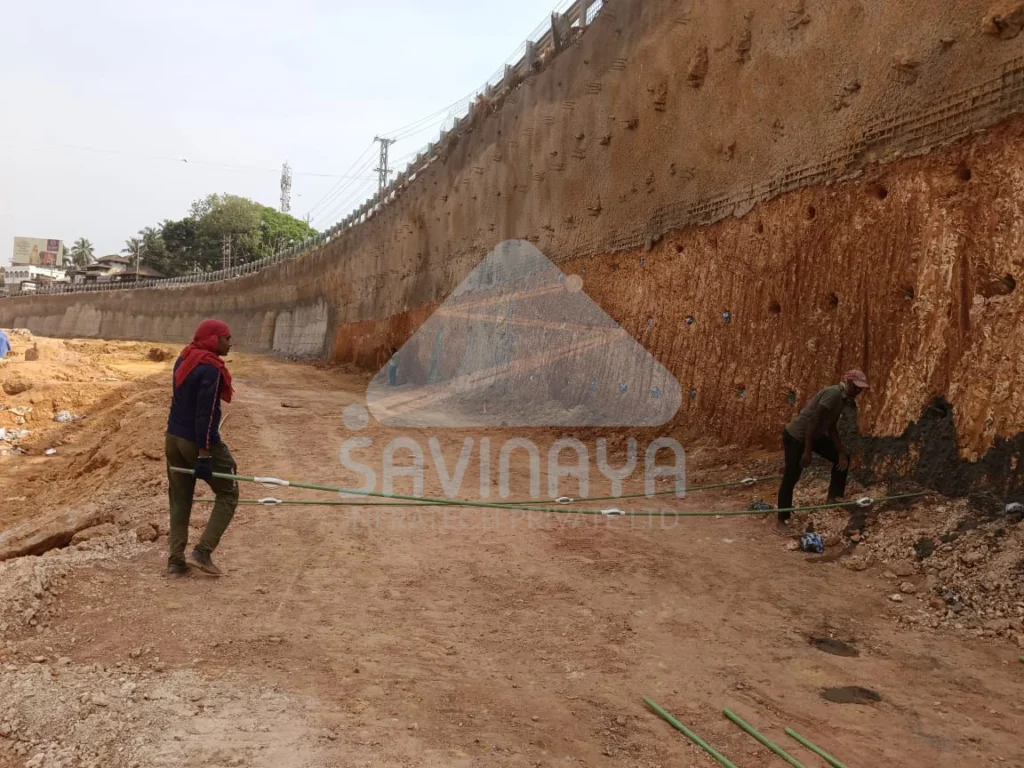
The service life of soil nailing depends on its intended design life, soil and groundwater conditions, corrosion environment, steel protection, grout quality, facing durability, drainage, construction quality, and maintenance. Permanent systems require appropriate corrosion protection, durable facing, and effective drainage. Inspections should be carried out after heavy rainfall, seepage, erosion, new cracks, settlement, or changes in loading near the slope crest.
Why Choose Savinaya Infra Tech for Soil Nailing Services?
Savinaya Infratech provides soil nailing, soil anchoring, reinforced soil slopes, gabion walls, erosion protection, shotcreting, retaining-wall services, and rehabilitation of unstable RS walls using soil nailing. The company highlights a management team with more than 25 years of experience, specialised equipment, a dedicated project team, and the construction of India’s deepest vertical soil-nailed wall for NHAI.
By evaluating the soil condition, slope geometry, water conditions, and project requirements, Savinaya Infratech can help identify an appropriate ground-stabilisation approach for slope, excavation, or retaining-structure challenges.
Conclusion
In conclusion, soil nailing is an effective and affordable way to ensure the stabilization of soil in various construction projects. It offers long-lasting stability, safety, and cost savings. As a soil nailing company, we are proud to provide expert soil nailing services that help our clients build stronger, safer structures. If you’re looking for a reliable solution for soil stabilization, Contact Us today to discuss your project needs and find out how we can help ensure stability and strength.
FAQs
What exactly is soil nailing?
Soil nailing is a ground-stabilisation method that strengthens an existing slope or excavation by installing closely spaced steel bars, called soil nails, into the soil. The nails are typically grouted and connected to a facing system made of mesh, shotcrete, bearing plates, and drainage elements. Together, they reinforce the soil from within and help it resist outward movement, erosion, or collapse.
How does soil nailing work for stabilizing slopes?
For soil nailing for slope stabilization, soil is excavated or treated in shallow stages from top to bottom. At each stage, holes are drilled into the slope, steel nails are installed and grouted, and the exposed face is supported with mesh and shotcrete. As the soil tends to move outward, the nails develop tensile resistance and transfer forces into more stable ground behind the potential failure zone.
How deep are soil nails installed?
Soil-nail depth, or nail length, is determined by the approved design and site conditions. As a general reference, soil nails are commonly at least 15 ft (about 4.5 m) long and often range from 0.7 to 1.0 times the designed excavation height, with longer nails used when required for stability. The final depth depends on soil strength, slope geometry, groundwater, loading, and the location of the potential failure surface.
Is soil nailing a permanent or temporary solution?
Soil nailing can be used for either temporary excavation support or permanent slope and retaining-structure stabilisation. The difference is determined by intended service life, design requirements, corrosion protection, facing durability, drainage, inspection, and maintenance. For example, one highway agency defines structures intended for 18 months or less as temporary and those intended for longer service as permanent.
When is soil nailing not suitable?
Soil nailing may not be suitable where the excavated face cannot remain stable during construction, drilled holes cannot stay open until nails are installed and grouted, or groundwater is uncontrolled. Other challenging conditions include loose saturated soil, very soft soil, highly corrosive soil or groundwater, and sites where property boundaries, utilities, or nearby structures prevent the required nail length.
What is the difference between ground anchors and soil nails?
Soil nails are generally passive reinforcement elements. They are typically fully grouted along their length and develop tensile resistance only when the soil or wall begins to move.
Ground anchors, also called tieback anchors, are active elements. They are post-tensioned during installation to apply restraint immediately, and they usually have an unbonded free length plus a bonded fixed length in stable ground. Anchor systems are commonly selected where higher individual loads or immediate restraint are required.