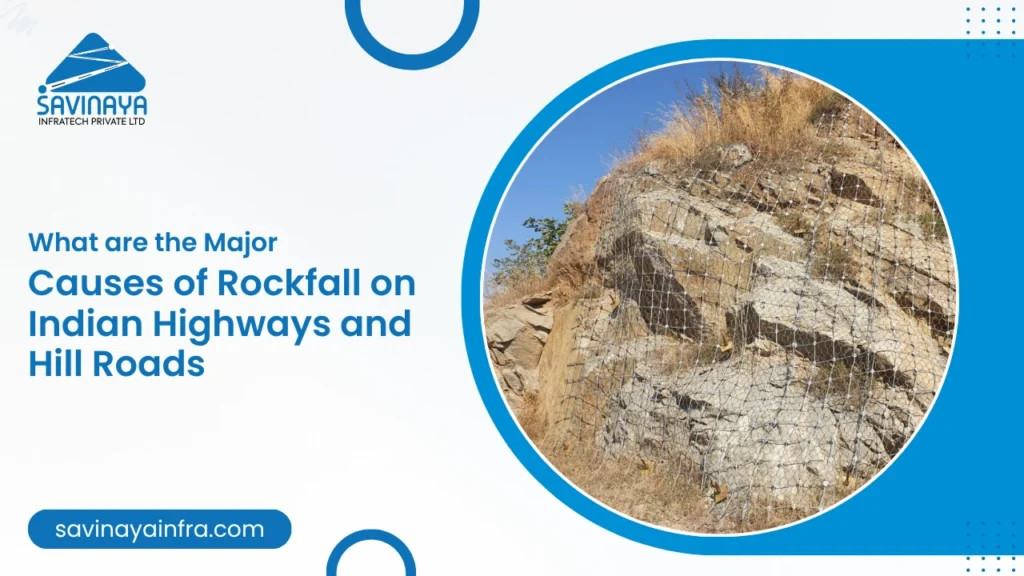
Across India’s hill roads and highway corridors, rockfall is a recurring safety challenge. Every year, falling rocks block traffic, damage vehicles, and threaten lives, especially along steep cut slopes in the Himalayas, Western Ghats, and other hilly regions. While rockfalls can seem sudden, they usually result from a combination of natural processes and human activities acting over time.
Understanding the key rockfall causes is the first step toward designing safer roads and more resilient slopes. When engineers, contractors, and authorities know what drives rock slope failure, they can plan better rockfall protection, improve maintenance, and invest in targeted rockfall mitigation measures.
In this blog, we’ll look at five major causes of rockfall on Indian highways and hill roads, and then discuss practical rockfall prevention strategies.
Key Takeaways
- Rockfalls on Indian highways and hill roads are driven by a mix of natural processes and human activities, not single events.
- Heavy rainfall and water seepage are the most dominant triggers, weakening rock joints and increasing slope instability.
- Seismic activity in regions like the Himalayas can suddenly dislodge already fractured or unstable rock masses.
- Long-term weathering and erosion gradually weaken rock strength, making slopes more prone to failure over time.
- Poor drainage and lack of proper slope protection significantly increase rockfall risk, especially during monsoons.
- Effective prevention requires a combination of drainage systems, rock stabilization, protective structures, and regular monitoring.
Table of Contents
5 Main Causes of Rockfall on Indian Highways and Hill Roads
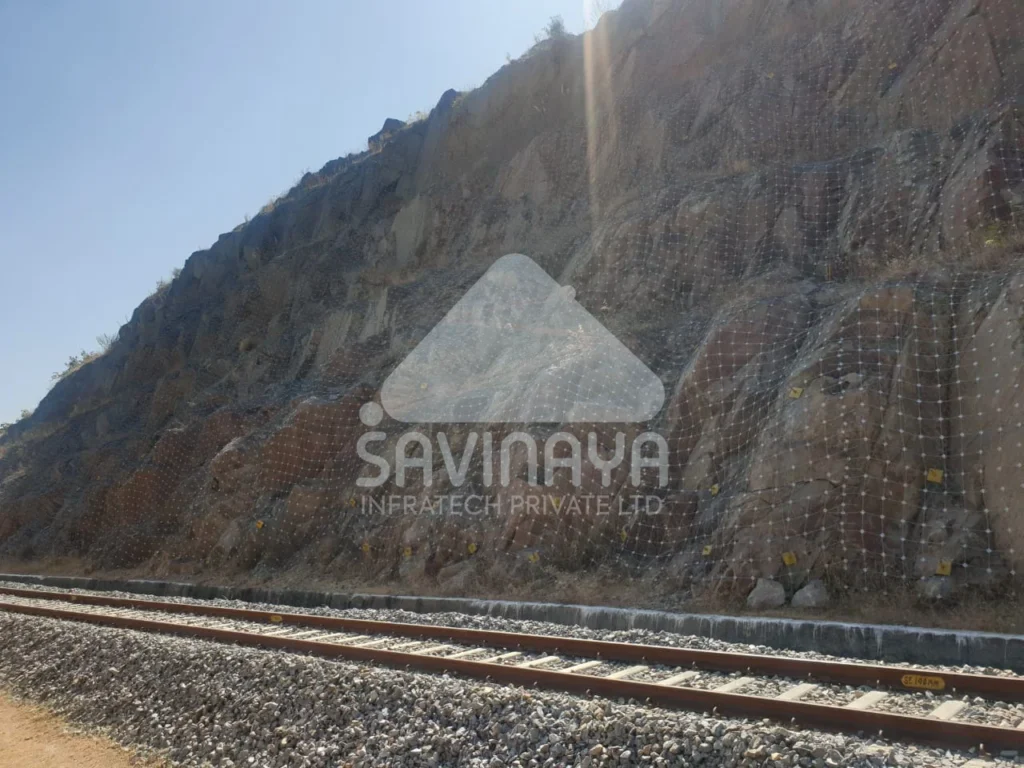
Rockfall rarely happens due to a single factor. Instead, multiple rockfall causes interact—water, weathering, seismic forces, vegetation, and drainage all play a part. Here are five of the most important ones.
1. Heavy Rainfall and Water Seepage
India’s monsoon delivers intense, prolonged rainfall that can dramatically change how rock slopes behave. Heavy rain and continuous water seepage are among the most significant rockfall causes on hill roads.
Water affects rock slopes in several ways:
- It seeps into joints, cracks, and bedding planes, reducing friction and making it easier for blocks to slide.
- It adds weight to the slope, increasing the driving forces pushing rocks downward.
- Repeated wetting and drying cycles weaken weathered rock and open up existing fractures.
In some regions, freeze–thaw cycles at higher altitudes further worsen the problem as water inside cracks expands and contracts, gradually prying blocks apart. Over time, this leads to rock slope failure when the weakened blocks finally detach. Without proper drainage and rockfall protection systems, heavy rainfall can quickly transform marginally stable slopes into active rockfall sources.
2. Seismic Activity
In many parts of India, especially the Himalayan belt and other seismically active zones, earthquakes and tremors are another critical factor in rockfall causes. Even moderate seismic events can:
- Shake loose already fractured rock masses
- Widen existing joints and create new discontinuities
- Trigger sudden failure of overhanging or marginally stable blocks
Because many Indian hill roads are cut into steep rock slopes, they’re particularly vulnerable when strong shaking coincides with weakened, weathered rock. Seismic events can cause both immediate rockfalls and longer-term instability that shows up as delayed rock slope failure. This is why rockfall mitigation strategies in such areas often need to account for both rainfall and seismic loading when designing rockfall protection.
3. Weathering and Erosion
Over time, all rocks weather and erode. In a highway cut or hill road, this process is often accelerated because slopes are exposed, steepened, and sometimes stripped of vegetation. Weathering and surface erosion are therefore major rockfall causes, even if they act slowly.
Common processes include:
- Physical breakdown due to temperature changes and repeated expansion–contraction
- Chemical weathering that weakens rock minerals and joint infill materials
- Surface erosion driven by wind, rain, and runoff removing finer particles
As the rock mass weakens and fractures widen, thin slabs, wedges, and blocks become more prone to detaching. Without ongoing maintenance, scaling, and rock slope stabilization measures, these cumulative changes can lead to frequent small rockfalls and occasional larger failures.
3. Vegetation Growth
Vegetation might seem like a stabilizing factor, and in many cases it is, but uncontrolled or inappropriate vegetation can also be one of the subtle rockfall causes. Roots can:
- Penetrate existing joints and cracks, gradually prising them apart
- Introduce water and organic acids into fractures, promoting further weathering
- Create additional pathways for water to enter the rock mass
On steep rock faces, trees or large shrubs growing on narrow ledges can add weight and leverage to already marginally stable blocks. When such plants topple in storms or high winds, they may pull rock fragments with them, contributing to rockfall events.
This doesn’t mean vegetation is always bad when planned and managed, it can play a positive role in slope failure prevention on soil and mixed slopes. But in rock slopes, especially where roots penetrate deep into fractured zones, vegetation can become a contributing factor to rock slope failure if not monitored.
4. Poor Drainage and Lack of Slope Protection
Human factors are often as important as natural processes when it comes to rockfall causes. Poor drainage design, clogged drains, and lack of basic rockfall protection can turn manageable slopes into high-risk areas.
Key issues include:
- Blocked or undersized drains that cause water to overflow onto slope faces
- Inadequate provision for surface runoff, leading to uncontrolled erosion
- Absence of rockfall barriers or netting, or other rockfall protection systems in known hazard zones
- Cutting slopes too steep during road widening or construction without proper support
When slopes are left exposed without rockfall mitigation or rock slope stabilization, small defects grow larger with each monsoon. Over time, this neglect manifests as frequent rockfalls, damage to retaining structures, and increasing maintenance costs. Proper drainage and early investment in slope failure prevention are therefore essential to managing rockfall risk.
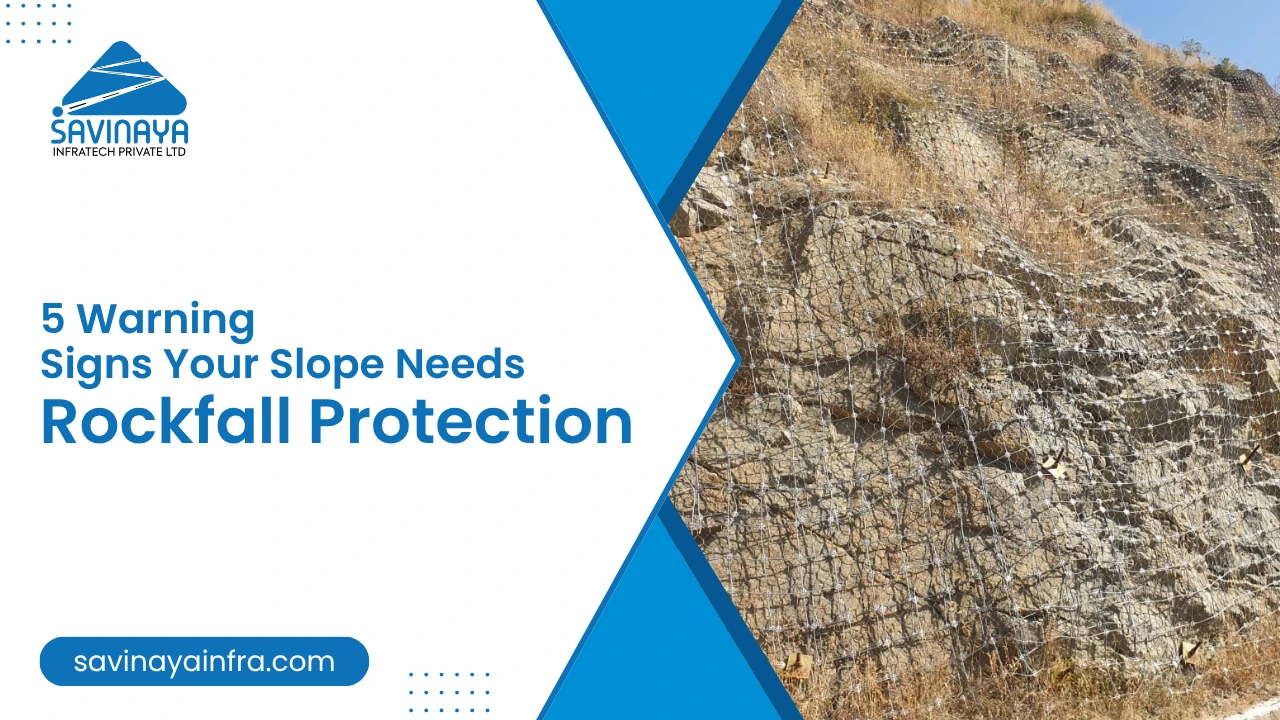
You May Also Read: 5 Warning Signs Your Slope Needs Rockfall Protection
What Are the Preventive Measures to Reduce Rockfall Risks?
Once we understand the main rockfall causes, we can focus on practical rockfall prevention measures for Indian highways and hill roads. Effective strategies typically combine engineering solutions, good drainage, and ongoing maintenance.
Some common preventive measures include:
1. Improved Drainage and Water Management
Designing and maintaining surface drains, sub-surface drains, and culverts to ensure water is safely diverted away from rock faces and embankments.
2. Rock Scaling and Controlled Removal
Periodic removal of loose or marginally stable blocks under controlled conditions, reducing the inventory of potential rockfall sources.
3. Rock Slope Stabilization
Use of rock bolts, anchors, shotcrete, and other structural supports to secure fractured rock masses and reduce the chance of rock slope failure.
4. Rockfall Protection Systems
Installing rockfall protection systems such as rockfall barriers, draped nets, fences, and catch ditches to intercept falling rocks before they reach the road.
5. Protective Facings and Gabions
Using flexible facings, gabion structures, and other retaining solutions to support weathered sections and manage surface erosion.
6. Monitoring and Inspections
Regular visual checks, detailed geotechnical inspections, and, where needed, instrumentation to track changes in critical slopes over time.
The right combination depends on site conditions, traffic importance, budget, and the specific rockfall causes at play. In high-risk areas, it’s often more cost-effective to invest early in robust rockfall mitigation than to repeatedly repair damage and manage frequent closures.
You May Also Read: How Rock Fall Protection Systems Help to Prevent Landslides and Improve Safety
Choose Savinaya Infratech for Reliable Rockfall Protection and Mitigation Solutions

At Savinaya Infratech, rockfall protection is focused on long-term strength, safety, and stability for highways and hill roads.
- Engineered solutions: Site-specific rockfall protection systems using rockfall barriers, netting, and custom configurations.
- Precision design: Systems tailored to slope angle, rock size, and fall zones for efficient rockfall mitigation.
- Expert installation: Skilled teams ensure accurate execution and dependable performance on site.
- Practical approach: Personalised, honest solutions that avoid overengineering while keeping safety first.
- Proven quality: Experience on national highway and infrastructure projects with a strong focus on durability and safety.
For companies seeking reliable rockfall protection and mitigation solutions, Savinaya Infratech helps turn high-risk slopes into safer, well-managed assets.
Conclusion
Rockfalls on Indian highways and hill roads are not random events they result from a combination of natural rockfall causes and human factors. Heavy rainfall, seismic activity, long-term weathering, vegetation, and poor drainage all contribute to rock slope failure if left unchecked. The good news is that many of these risks can be significantly reduced through thoughtful rockfall prevention, better drainage, and well-designed rockfall protection systems.
Noticed recurring rockfall issues on highways or hill roads? Get in touch with us to plan reliable rockfall protection solutions.